"Joseph Horovitz Centenary“. John Wilson and Kenneth Hesketh in conversation about their teacher Joseph Horovitz
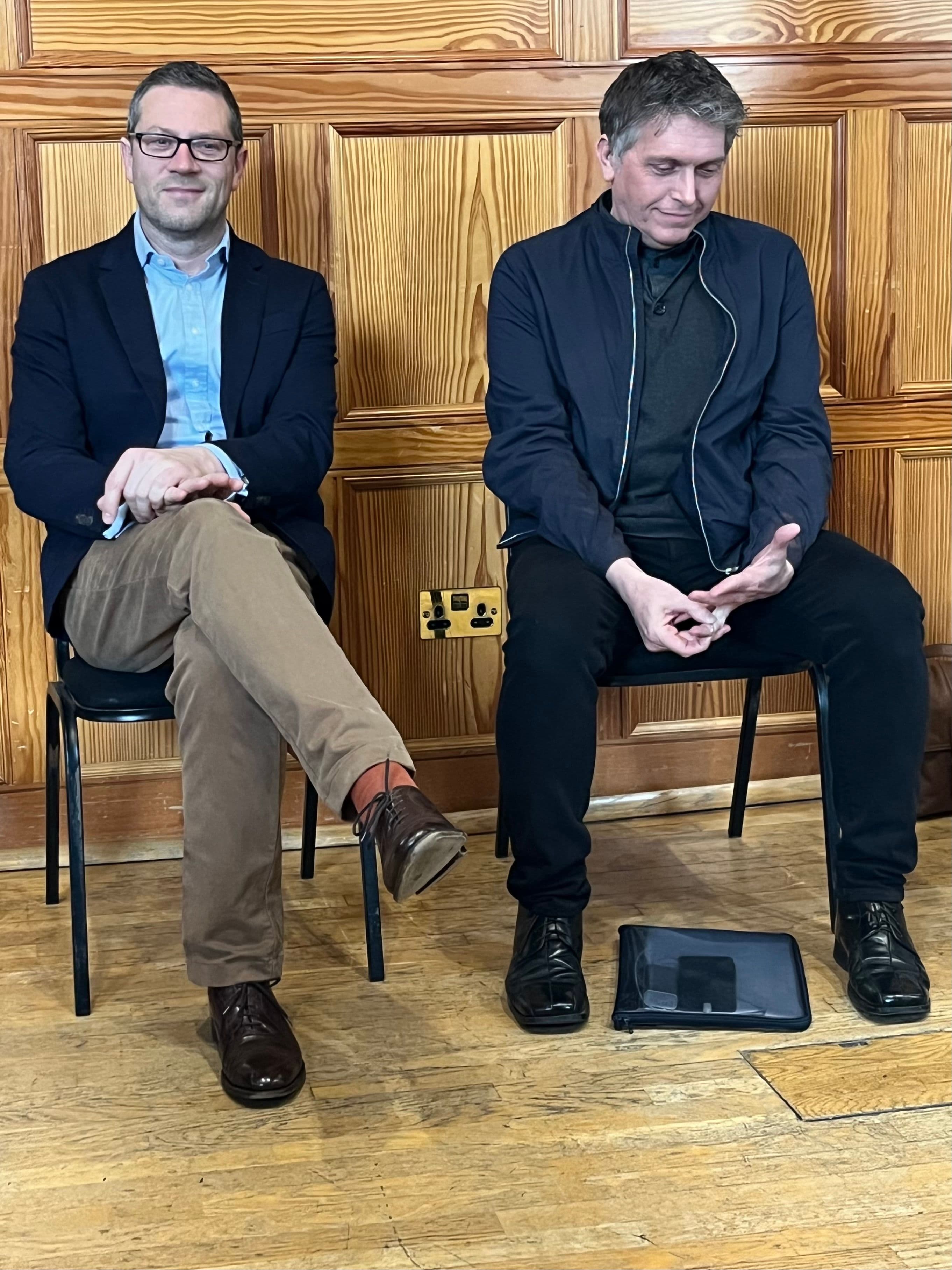
To mark the centenary of the Vienna-born British composer and conductor Joseph Horovitz (1926-2022), the website of the Joseph Horovitz Collection and Archive was launched at an evening held in the Carne Room of the Royal College of Music (RCM), London, UK, on 6 May 2026. The college regards it as the most substantial donation since the Herbert Howells archive in the early 1980s. It represents a resource for performers, scholars and listeners, and as well as illuminating Horovitz´s life and music, offers rich documentation of twentieth and twenty-first century British musical life in general.
The archive contains manuscripts, sketches, autograph scores, arrangements, correspondence and associated materials relating to virtually all of his works, including over seventy scores for TV and film. The archive also contains around fifteen hundred items of correspondence, catalogued works, and additional compositions beyond the printed and previously known lists.
[My recording and my transcript]
Ken Hesketh I have a question. What was the first piece of Joe Horovitz to you? And how old were you?
John Wilson Probably when I was a kid. Before we open that ... my lessons, as yours probably, were all on one day, and Joe said, did you have a nice weekend?
And I said, yes, I had foie gras for the first time. [LAUGHTER]
And he said, oh, John, how could you? He was kind of disgusted. And two days later, a copy of that song (i.e. Horovitz´s setting of Michael Flanders´s text on Gluttony from The Seven Deadly Sins) arrived. [LAUGHTER]
I shouldn't say anything at the time, but ... but yes, the first piece I knew, of course, was Captain Noah, which I'd sung as a kid in the unison version, and then I had played the drums in the production with one of the schools in the North East, and then I played the drums with the SATB [Soprano, alto, tenor, bass] version. So, I was aware of that. And of course, some things I was hearing, sure.
And … you know … I came to college as a percussion player, and I didn't want to be a percussion player. I knew I was going to be a conductor from when I was 14. I´d done quite a lot of conducting as a teenager.You couldn´t come to college as a conductor. And one of my teachers said, look, you play percussion in orchestras and brass bands. I had played percussion all my childhood.Try to audition at the college as a percussion player, just get yourself through the door. And I said, I don´t want to be a percussionist.It would be a lie. “Just do it.” So I did it. And I got in as a percussion player, first study. And almost instantly, I knew that this was not going to work, because I had absolutely zero interest in what I was going to do. I knew what I was going to do. And I thought I had to come clean. And I said to the head of the students, I´m coming as a percussionist. What they´re asking me to do I'm not interested in that. It's a waste of time. I think I should leave. And they said, well, look, have you thought about switching to something which would be more useful, like composition?
And I said, well, I don´t want to be a composer. And I said, I´ve written a lot of arrangements. That´s something I've always done. I had noticed there´s enough bad music in the world that may add into that. And they said to me, well, you must meet Joseph Horovitz, because I think he´s the kind of person. And I was like ... but he´s famous. He´s too famous for the life of me. And I was given a sort of … like … I guess it was a kind of friendly consultation meeting with him. And he put me at ease straight away and didn't talk about composition. In fact, I remember he said to me something very interesting, he said, “I never studied composition.” He said, “When I was at Oxford, I studied music.And they made me do exercises. It wasn´t called composition. It was just, well, it was academic, you know, fugue, harmony.” And I thought, well, okay, I can go with that. And I took in some of my arrangements. And from that moment, I had someone on my side. Because at the end of my first year, when I hadn't done any work on my percussion at all, I got a call at Nicholas King's office. He was the Vice-Director and Director of Studies. And he said, we're going to have to let you go. We're going to have to chuck you out of college. And Joe and Philip Robinson [conductor and arranger] saved my neck. They kind of weighed in and said, we need to have this guy. But you were there ahead of me.
Hesketh And you were also a person of my height. I was in awe. You were the one that could really do it. Oh, how old would we also turn? But I actually knew Joe´s music before I knew it was by Joe. There was a wonderful, as you probably know, there´s a great early 70s disc by the King Singers called Lollipops. And there was a wonderful arrangement. This was all afterwards, because it was a wonderful arrangement, this is all after this because I didn't know at the time of his great song Romance. And I just played this thing to bits. In fact, I had to buy it online … some kind of old record place, a new disc, because it just wouldn't play anymore. And then I actually, for the first time, looked at the back, and it said “by Joseph Horovitz”. And I thought, my God, even when I was, how old was I … nine … I had been aware of his music. And then, of course, as you did, I sang Captain Noah. And then, actually, because I was a tuba player at one point in my life I played in brass bands, as you´ve done with percussion. And I went to the Nationals in 1982, when Joe had written his wonderful piece for Ballet for Band.
Wilson That's true. That´s such a brilliant piece.
Hesketh And in those days, and I know they still do it, it was just a sheer thrill to get that little manky copy that Novello had always handed out. You know, really cheap. You couldn´t see half of it, not really. And I thought, this … I like that. I bought the score. And I was introduced to him by my brass band teacher. And Joe...
Wilson And this was when?
Hesketh 1982. And, again, you know, this little snotty ... I think it was after I was out of short trousers, I´m not sure. But he, of course, took the time, said, you know, “are you interested in music?” “Well, yes, I want to be a composer. I've written something for a brass band or something.” And that, for me, was one of those moments where I thought, if I´m lucky, if I´m really lucky, I might see him again, just maybe talk to him about music.
Wilson And was the fact that Joe was on the faculty here one of the main decisions you came up? How did that work?
Hesketh There were two people, actually. And, again, I´ve been so lucky in my life to know really wonderfully warm and intelligent and, in their work, elegant writers. And, actually, of course, Edwin Roxburgh and Joseph Horovitz both studied with [Nadia] Boulanger of course. So I was sort of, I don't know, sort of the grand-son of Ed Roxburgh ... And it was both of them that I thought ... because actually I´d got a place at York University, I'd got a place somewhere else, somewhere else, and, actually, it was Edwin that rang up the weekend before and said, look, you can get to London. There's a scholarship. Would you be interested in studying with me? That's a whole different story. But I looked at the perspectives just to see who was on that list. And here we go. I can possibly do it. And so that's why I changed my mind because of both of them.
Wilson You know, looking back, because this is … we were … and you came to college, right? 18? 18. I started in 1990, I think. I was one of the [?] at that point.
Hesketh I was 21, yeah. And just speaking from the fact that the composition faculty, it was ... I felt it was sort of pretty hard line. It wasn't an easy time to be yourself. There was a lot of water between what one got with Joe and basically everyone else.
Wilson And, you know, we used to have these ... in the Dorrington room on a Monday, do you remember, or a Wednesday, when everybody had to write a piece of music that was played by a group? And it was kind of like … either you wrote sort of “new complexity music-17“ at the time or, as Richard (Rodney Bennett) used to refer to it, or nothing at all. And it was ... it wasn´t a very nice environment. And Joe was my kind of refuge from all of this, because Joe absolutely understood what it was to write… “useful” music, music that people want to hear, music that people want to play …
Hesketh … and music that people enjoyed …
Wilson Yeah, and God forbid! [LAUGHTER] But, I mean, it's different now. It's different now. You know, this is 30 ... How many years ago?
Wilson 30 … yeah … years ago.
Hesketh In fact, you know, it's an interesting thing. Not that long ago, I got a letter, an email, from someone who was involved in composition teaching here. And he said, you know, I've been thinking about this for a long time. I just want to write to say sorry. Interesting, isn't it?
Wilson Well ... Because the doctrine was so sort of hard and like that. But Joe was apart from that. And this business of me not fitting in and … not wanting to be a composer, knowing I was going to be a conductor, and Joe recognised that from day one and cut some slack when it was possible. So basically, every Monday, we would have chats about music. He would talk about all the great masterpieces of the world and the byways of music, and he was my music teacher, you know. And at the time, I suppose you just take it for granted. You´re like I´ve chatted to Joe Horvitz for ninety minutes on Monday. But looking back now, I think he's one of the two or three most profound influences as a musician, especially as a conductor. Because, you know, Joe had a lot of experience as a conductor. I was thinking composition almost got in the way of him being a conductor because he loved conducting, he loved performing, he loved talking about it. He used to tell me all sorts of memories about his early days conducting at the Festival of Britain in 1951 and all that. And I think he recognised something within me that was genuine about conducting. And then it was a great … honour really to get to conduct his stuff. I conducted his 70th birthday concert at St. John´s, Smith Square, which I organised because I fell in love with his music. I fell in love especially with his Violin concerto, which I'm actually doing next year. It´s one of the … it´s such a great, such a great work. You know, this archive [the Joseph Horovitz Collection and Archive is hosted at the Royal College of Music Library in London, featuring autograph manuscripts, working papers, and Joseph Horovitz´s correspondence] is wonderful because there´s so much to discover there.
Hesketh I´ve been looking through it. It´s incredible, actually, the depth of his output, also just his humanity. And I think what´s wonderful about my time with him is he really was an island of absolute sanity and calm and maybe, dare I say, love because I was having a really … it´s funny, all the best people have hard times at college [LAUGTHER] … you don´t have to say. And I was going through this really, you know, this major dichotomy of what kind of composer am I going to be. And I had various teachers and there was something that came up by one of these teachers that said, you know, I´m not sure I can deal with this split loyalty. And it wasn´t Joe. And, of course, Joe was really supportive and said, you know, just write what you want to. Write what feels authentic. And that's something I seem to say to my students now: If it's not authentic and if you feel like you're having to strike a pose on doing something that you think someone else wants to do, it will never work and it will never feel like it's yours and it will actually come through the music in that way. And I was, as you were, we talked about all sorts of things and one of the things we enjoyed looking at was, of course, orchestration and we went through the whole of Tom Lehrer [?] – bar by bar. Just to say: “this is wonderful,this doubling here!”
Wilson That business of polish and finish is what I learned. I mean, you know, I always appreciated the craft of composition but he took it to another level.
Hesketh Absolutely!
Wilson And at the time at first I was like … really? [LAUGHTER] I remember once writing a dotted crotchet and he said, no, it´s a dotted crotchet tied to a quill and a cradle rest and things like that and how … the exact duration of a good start and all this, and at the time at first I was like, well, this is a bit fussy, but of course I'm grateful to him for the whole rest of my life now because that level of finish … um … music is activated by that and not only in the writing but in the performing of it and so it all sort of …
Hesketh I think as a performer that clearly informs how he wrote. That´s why things are gracious on the page and they are gracious in the performance because there´s that attention to detail, the logic behind what was necessary. There's nothing extraneous in there, but it´s all elegant.
Wilson But, you know, there are some composers who have only that, whereas Joe didn´t put pen to paper unless he had an inspired idea. And it looks … you know, you mentioned that Ballet for Band, which I heard the other week because I went up north and there was … the Easington Connery band were rehearsing. So I thought I'm going to go along … and I was just struck by how marvellous the music is, how great the tunes are, how well-written it is, how inspired it is, but also how there isn´t an ounce of fat on it.
Hesketh Yeah.
Wilson There's not a note there which doesn´t benefit you or serve a purpose. And that all happens within the eleven minutes ... the Imaginary Ballet and the scenario that only he knew. And I wonder if anybody … I wonder if Anna [Horovitz] knows it … he must have told someone the scenario behind it. That´s hilarious. It´s a bit of a different thing but you know you've heard the examples of humour – and joke would be very important.The joke – and Joe could be very much in the foreground, Joe could be quietly, devastatingly funny.
Hesketh Acid!
Wilson I remember once George Hurst coming to conduct the orchestra in college, and he was brilliant, absolutely brilliant … but terrifying.And we were frightened. I remember coming along the corridor once, I just looked at my shoes. This great maestro and when he came up we obviously could hear a pin drop and he was the scariest person anybody had ever seen. The pianist reduced to tears and doing a Beethoven concerto, I remember, and just this thing. Everybody was terrified.
And he was coming out of the concert hall … and he had a wig. He had a very prominent two-piece. It was … you could see it from a mile [LAUGHTER], a very obvious wig. And we were so frightened we didn't even look at his hair. [LAUGHTER]. That's scary. And I remember him coming out of the concert hall up the stairs with this baton and this music, and Joe was coming in just round the corner and he said, “George! I haven't seen you for decades.How are you?” And innocently, they had a brief conversation, and then as he was leaving Joe said, “Nice hair!” [LAUGHTER] After that …after that George Hurst became human … he humanised him for us. We were no longer so terrified.
Hesketh Well, I mean, I think Joe Horovitz is a great example also of how that elegance of harmonic thinking can make one smile constantly. There is just a beauty in the modulation. There´s a wit in the way where it happens and yet somehow we always get home.There´s that wonderful ability just to keep going further out but then bring it back. And it´s not just, you know, it's not sound music. There's some really rather fruity things going on in there.
And I think that´s the other side, I think, of Joe´s work that I wish I´d known sooner, for example, the 5th quartet. But then, which is, I mean … even to my students who have no interest in “that sort of” – whatever that is – “music”. So, you know, if you want to sort of see what a good string quartet is, that´s one. I also say, what would you choose as language. And I consider on par just different ways of working with a quartet. And again, it´s just that wonderful ability to write something that is really heartfelt but it´s just communicated with the most wonderful economy of means. And, you know, it must have been difficult to be a composer here, born in 1926, when the BBC, after the war, basically, with William Glock, basically, we were all alone.
Wilson And it´s a tricky thing to ponder because I remember talking to Richard [Rodney Bennett] about this very same thing, about, you know, that sort of thing, the Glock era, and it's a bit like, you can't sort of reduce this to a simple thing, but, you know, if it's modern, it's in, if it's not, it's out. And Richard said, well, it had to happen. It just had to happen. He said, we couldn´t go on having dominant sevenths and, you know, whatever it was. But at some point, in amongst all the good stuff that happened, there was good stuff that happened – we did throw the baby out of the bathwater. I don´t mind saying that, we definitely can´t say that … and Joe was someone who didn't really … how shall we say it … he was a bit of a life raft in that he refused to sort of give up on the principles in which he believed. They were too deep-rooted, they were too broad. And I guess he showed that there was another way. There was a different path that he could take. And it wasn't backward-looking at all. It was purely a respect for things that were, obviously, really important.
Hesketh Yeah, I mean, I would say that if there was a place where one wouldn't necessarily expect that kind of ability, that, you know, kind of elegance, is all the commercial, so to call it,work that he did.That´s all these miniscule little cues in, say, Dorothy L. Sayers [A Dorothy L. Sayers Mystery; Lord Peter Wimsey;a series of television adaptations of three Lord Peter Wimsey novels, BBC Two, 1987] or Wessex Tales [Wessex Tales was a six-part British television anthology mini-series that adapted the short stories of Thomas Hardy], that, or even Rumpole of the Bailey [a British television series created and written by the British writer and barrister John Mortimer; seven series of Rumpole of the Bailey were made from 1978 to 1992, each consisting of six episodes. A special two-hour film, Rumpole's Return, was made and aired in 1980, between the second and third series. The author, John Mortimer, occasionally appeared as an extra], even just the dance arrangements that you would use on the show, every one of them was beautifully realised … his arrangements and his orchestrations. And they were done with … um … five instruments and in A Dorothy there was so little to it. And yet it always sounded like it was just, it was rich, and he was an incredibly pragmatic as well as able composer.
Wilson Yeah, but you can tell that he sweated over it because that degree of finish, doesn´t it?
Hesketh Yeah.
Wilson I remember once talking to him, he was sitting in that room number 2, or wherever it was, and he said, do you know the song Ain´t She Sweet [1927; Milton Ager (music) and Jack Yellen (lyrics)]. The Queen Mother´s coming to college, and we're going to give her a medley of songs that she loves … instead of some terrible old symphony that she´s going to be bored to tears … but we´re going to play songs from the 1920s. And I remember him, I remember … the piano, and he said … … is it THIS … [Hesketh playing] … or is … is it [much, much slower tempo – largo maestoso... ]. And that´s the sort of thing that could take up half an hour and you would talk about repetition versus the first inversion and all of that, because ultimately it was the composer´s job to sit and work through all of the hard stuff.
Hesketh And it was due diligence. It wasn´t anything special, it´s just what you did. I remember so many times I would take him whatever. In fact, the [?] I wrote for you that came out of us having worked for Craig [?] for … [?] when I was maybe 20 or 30. And every time I would take it to him and play it to him on the piano he´d say, “No, no, no. There, that voiceline is really terrible. And you should consider this.” And, of course at the time I´d go ... well, no, actually. And then of course I´d go home and … he goes … well, of course.
Wilson And after I´d finished college, I remember making the transition from student to friend. And I felt that was a very great honour. In fact, I called him Mister Horovitz until I left college and I remember once the doors were closed and he said, now John, I´m Joe. John, and he gave me permission to use his ... “Du”, I guess.
Hesketh Yeah, yeah.
Wilson And from that time onwards we just became friends and colleagues. I could ring him up any time and talk about things. And I got to conduct some of his music and continue to. And it was one of the great privileges of my life, really.
Hesketh I absolutely agree with that. I would say that going to Dawson Place was always a wonderful time. I never, ever wanted it to end. I´m sorry if I outstayed my welcome every time … because there was that wall of CDs. Everything was beautifully ... there. The grand piano had wonderful ... There was the family that was there. And never mind the many references. He must have been sick of writing references. And he always typed it - mostly - very well. There was some sort of Tipp-Ex [Wite-Out (Am)]. And I think that he really did care about what happened to his students. He really did follow them on.
Wilson And you're right. I mean, having had that kind of friendship with “Mister Horovitz” was … it was, it was something that one felt very, very thankful for and a little proud of. And you know, just before the last year of his life, I said to him, I want to conduct the Violin concerto [op. 11; 1950]. I´m going to record it. And he said, well you can´t because I have to finish it. And I said, “what do you mean you've got to finish it? You´ve done it. I´ve done it before.” “You´ve done it? No, it´s not right. I need to … I need to sort it out.” So we started on this … this business of editing the Violin concerto … pages and pages of notes. I think it was just a couple of weeks before he died, I got the last page of notes. And literally halfway down the page, the writing stops. And I´ve been … I´ve since been going through it. I´ve done all of his notes and I´m now carrying on in the same vein of what I knew. If the pen had gone on down the page, I know what he would have said because his … his techniques and his craft, I absorbed so much of it that I feel fairly confident that I can finish the work …
Hesketh … in a manner …
Wilson ... yeah, in a manner which I feel that I can handle. And we are, and we´ll get to do it next year. And as you say … it´s a great, great honour …
Wilson Absolutely. And I don´t think, I mean, I can´t really think … I´ve been very, very lucky like I said before. I´ve known people who … the ones that stand out are the ones that sort of have a cosmopolitan flair … that … they …they know so much, they may not agree with it, but they are always, always informed and ready to talk and ready to change ideas. And that was one of the great things in my relationship later with Joe. There was just something about his ability to almost sum up a century as well actually, of musical endeavour, of living, living a life well lived, that´s what I would say. Even though he complained about the bones … all over the hand [?]. But I would also say that he always found … he was always busy, his mental energy …
Hesketh He was there, in the library. I remember him saying when he was in his 90s … “I'm very glad I´m a perpetual student.I´m always a student.” And that's the way that gets you out of bed early in the morning, doesn´t it, that kind of curiosity. I mean, he was in the library more than any student ever was. [? He taught us that…] … lesson … Shall we leave it at that?
Wilson Yes, let´s end with that. Thank you very much!