Hearing Secret Harmonies. An Encounter with Anders Eliasson, Anarca
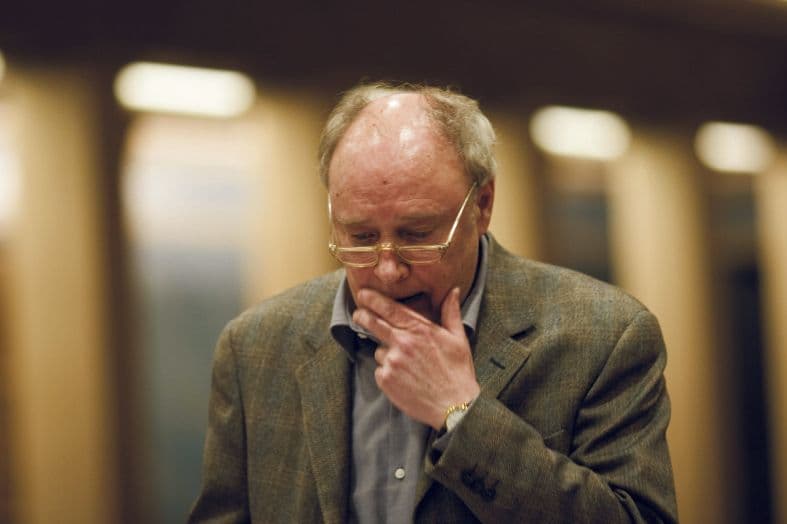
Peter Kislinger
Hearing Secret Harmonies. An Encounter with Anders Eliasson, Anarca
[Highlights, 2004/ vol. 3]
I have often heard concert-goers say of a contemporary piece of music, "But it wasn't modern, was it?" I find this kind of evaluative talk about 'modern, modernist, contemporary, advanced, innovative and new' music misleading, and I am more than a bit bemused by it. I don't think I'm your typical philistine. I am hungry for music of and for our time. So perhaps the question should be whether the music was original, individual, personal or unique.
When I meet Anders Eliasson in Munich for an ORF/Radio Ö1 interview, he claims he does not understand these labels. "There is only one universe, and only one music, despite different aesthetic attitudes." Then, without warning, he declares with brazen pathos, "The universe is divine. The 'modern era' has deified man. Modern – or rather modernistic – art reflects this arrogance. I am just a servant." It takes me some time to accept that Eliasson is speaking without irony, though he is perfectly capable of using this dangerous weapon.
The Finnish composer Kalevi Aho had spoken so glowingly about Eliasson's music that I had come prepared to meet a star, a monarch. Other eminent composers and performers have also paid tribute to Eliasson. When John-Edward Kelly, Eliasson's closest musical friend, fought for a decade to secure a German performance of Eliasson's formidable Symphony No. 3, he came to Munich to perform his Concerto for Alto Saxophone and Strings. He once played an Eliasson CD to the late Tristan Keuris, and the great Dutchman's first reaction was simply, "My God!" It is Eliasson who fires questions at me. Did I “like” the Concerto? He appears genuinely delighted with my reply. Does a composer of his stature need reassurance from a hack writer? During the break, I begin to realise that he does not primarily see me as a listener. "Anders Eliasson, human being."
A MATTER OF LIFE AND DEATH
There is no need for me to recount the story of his first life-saving encounter with music at the age of three, or his flirtations with jazz, etc. (www.musikmph.de/rare_music/composers), but when Eliasson says he was 'shocked' when he joined the composition class at the Royal Stockholm College of Music in the 1960s, I feel this is more than just a biographical detail given to journalists. The shock is still evident in his indignation.
When I met the "real" composers — i.e. composers of "New Music" — such as Karkoschka and Haubenstock-Ramati, I lost any connection to the music inside me.
Stockholm was a modernist metropolis in those days:
Dodecaphony, serialism, you name the movement, the trend, the fad, the technique — we had it.
For Eliasson, learning these techniques was "no big deal. It was all about techniques rather than making music and telling the truth."
As if sensing my unease, he stops. ‘You understand?’ Then, with almost no trace of irony, "The truth! It was a matter of life and death to me." Artistic integrity? "No, survival! Without music, I wouldn't survive. Never has been."
Everything was about taboos: one was not allowed to use melodies or harmony, and rhythm was not to be metrical. Everything was forbidden.' This left him exasperated and flabbergasted, and finally depressed.
Then came "the revelation". In conversation and in his music, be it in the concert hall or on CDs, Eliasson conveys the impact of that revelation. He does so here and now in the Bavarian Radio studio. "It's so simple," he almost cries out.
Take water: H₂O. It's the same with music. Melody and harmony are like hydrogen, and rhythm is like oxygen.
I seem to understand – he is interested in pure water? Not even close! This time, he gives me a pleading look. "I need it for sheer survival. I cannot abide bluffing, which causes complications." One of these complications is that there are not as many performances of Eliasson's music as its quality and force deserve. Maybe he just needs to be more patient? "No, I've given up all hope. I'm not waiting any more." Seeing my concern, he adds, 'I keep writing; that's all I need. There are commissions."
A NEW TONALITY
Although he has spoken about his 'discovery' elsewhere, Eliasson still finds it difficult to talk about it. Perhaps he is reluctant because he finds it obnoxious to live in a topsy-turvy world in which he has to justify his 'musical alphabet'. Now, with musical movement, there is "tonality", which, for him, "is not the same as major/minor; it is a different kind of tonality. It is a different perspective from which to observe and understand the universe."
But, he insists, I must understand that it is a new tonality:
It is not constructed; it is not an invention. It is basic; simple, even. A trinity – like water! You understand? Just water. Fantastic! A revelation! I am still exploring it; I am now convinced that its potential is similar to that of tonality. It's so unbelievably, abundantly rich that I can't see everything.
So it is a system? No, not at all. Later, unprompted and with a pint of Munich lager in front of him, he starts drawing triangles within triangles within triangles. Arrows connect simple rhythmic patterns with both the "super triangle" and harmonies, and the formula of water. Modes? Lydian, Dorian? Yes and no; they enable him to move from one to the other (see Christoph Schlüren in Highlights No. 6 for details).
What I have told you and what I have drawn here is not a treatise. It has nothing to do with how I notate the music or how you hear it. It's nothing but a mental construct. And I am happy it is just that.
MUSIC GENERATES ITSELF
Can he describe how he works? No, because he is not the one doing the work.
A motif suggests itself. Then I must be cautious, since it has a will of its own. Music flows; music generates itself. I cannot add anything.
But he is surely admired for his masterly orchestration, supreme knowledge of counterpoint and stupendous technical skill? Eliasson's reaction is vehement; he almost flies into a rage. However, due to his protective passion for the music — which he insists is not his — he manages to remain genial. "If I attempted to compose or impose my will on the music, I would destroy everything." But there is work and discipline behind every bar. One can hear the density and complexity. He insists that he does not understand the process: "Almost every bar is a surprise. Only later in the score do I understand why it had to be that way." He looks almost tortured now.
One often hears that "music expresses a different kind of emotion from what is usual", but alas, we cannot say what that emotion is. I have learnt that musical expression — as with any other form of art — does not express a different mode of experience; rather, it is a mode of practice. Music is not superior to everyday life; it is merely "different". In Wittgenstein's words, it is a "different game" with its own rules. What Eliasson is telling me, then, is that he does not allow rules from outside the "game of music" to interfere with his music, so that it can become "MUSIC!"
Apart from other things, what sets Eliasson's music apart from that of his contemporaries is that what one gets in his music is not the expression of an experience; it is the experience itself. As a musician, he is not simply experiencing, contemplating and then expressing. Does he see them as a unity? "Absolutely! It would be a disaster if I tried to compose," he says, laughing out loud. "A composer who, after all, does not compose. There you are!" So what does he do? "Well, composing means putting together various ´masses´. I can't tell you. I warned you: I'm impossible. The impossible one!”
To illustrate that music is inextricably linked with his inner self, he offers an anecdote about his training in Stockholm. “It was solely and dreadfully intellectual,” he says. "Mind you, Haubenstock-Ramati was a lovely man, and Karkoschka was - intense.” The class had been set a task to write a graphically notated score for the following day. "I can't", he said.
I know nothing about these things. I had seen millions of these scores, but I did not understand how one could tie graphics together with music. ´This is an assignment.´ `It's impossible, Mr Karkoschka.´ ´You must.' Off I went, diligently drawing figures on three or four sheets of paper. Back to class. 'Fantastic! We've got to perform this piece.´ And perform it we did – to great acclaim by an ensemble from the music academy.
So? 'It wasn't authentic or true! All this pseudo-philosophical superstructure instead of music!” He almost sings the word with affection. Eliasson has returned to the present tense: "No, I cannot bear this."
Later, he returns to something that is clearly important to him.
So much of what is valued in today's music is merely instrumentation. For decades now, our problem has been harmonics, i.e. how to create movement. Movement requires harmonics, space and spaces. Spectral harmonics, among many other solutions, has become a favourite. But these solutions are contrived. They lack the internal tension needed for movement. One can orchestrate static material brilliantly, but it remains static. There are fantastic examples galore. But it is not music! Admittedly, I want to create a costume too. Clothing music is like clothing a naked human being.
A score strives to be music, so I must give it the chance to do so. Strictly speaking, music is inaudible. Ideally, music should not be orchestrated; music in its purest state has no instruments. But music has these fantastic shapes, forms and formations, and they are inaudible. Basically, it is superfluous. Impossible. I sound like an idiot when I talk like that. We are now getting lost in talk about deified composers, reputation- and myth-building, and the roles of managers, critics and audiences.
With a hint of malice, I quote Pierre Boulez, who, in 1981, declared that "any composer who has not felt the necessity of the serial method is worthless". Eliasson: "Yes! Yes! Yes! There you are." Before I can move on to another topic, he continues, "In 1983, I heard a Boulez piece for Paul Sacher – well, I thought, so after all, this man can write music. I've studied Boulez. It's interesting. What's missing for me is that final stage.” I quote Ligeti, who, in a Viennese newspaper in 2001, went on record as saying that he had "nothing but contempt for anybody who still writes tonal music." Eliasson: "Yes, thank you very much." Then that loud laugh again.
Music is inherently tonal. Ligeti is reputed to have said in Dresden that he was the only composer. Fine. Ligeti, then! The man wrote wonderful music. His early pieces for choir are particularly impressive – he was a very important composer.
Conductors and interpreters make more in an evening than a composer will receive for a score they have worked on for years. "It's a sick world. What music and life are about has sadly been lost. In Sweden and elsewhere, it's the economy, but the slogan should be 'it's the culture, stupid.´´ I quote a line taken from Eliasson's oratorio Dante Anarca: "Debellare superbos!" Does Eliasson identify with this Vergilian outcry?
It does indeed express what I feel. Exterminate hypocrisy, power, Mammon! I am beginning to sound like a bit of a radical now.
Is there not a vein of aggressive anger running through him and his music, and through all the arts? "Oh certainly", he laughs out loud again. "Anger and haughtiness can definitely be found in music, too — and above all in the music business." Is Eliasson beset by the deadly sin of pride at times, too? After a long pause: "I hope not."
Later, outside the studio, out of the blue: "I am sometimes very lonely. But I am nothing special; I am not extraordinary. Quite normal." I find this astonishing. I pluck up the courage to ask him if he needs recognition, acceptance or praise. "Oh, I know who I am." There is no irony or smile. I quote Sterne's Tristram Shandy to him: when confronted with the conventional 'Who, pray, are you?', Tristram replies, "Do not puzzle me, sir." Eliasson seems amused.
Reflecting on my thoughts, I am reminded of W. H. Auden's poem about W. B. Yeats, which reminds us that poets must be permitted to be human in private, to be, as Auden provocatively puts it, "silly like us. Their gift survives us all." In life, therefore, there would be no need for Eliasson to resemble Dante Anarca, the eponymous hero of his magnificent and formidable oratorio. Yet Eliasson, the anarch who has overcome the aesthetics of the work in progress and the fragmentary, can afford to write "affirmative" music, free of both sentimentality and the stigma of cold calculation. He is one of the few people I know who enables everyone they meet to become an anarch — not an anarchist — as well. 'In the prison of his days / teach the free man how to praise.' (W. H. Auden).
It is a scandal that works such as the Sinfonia per archi, Ostacoli, Desert Point, Symphony No. 3 for Alto Saxophone, Concerto for Alto Saxophone and Strings, and his Concerto for Bass Clarinet and Orchestra have not yet entered the core repertoire of famous symphony orchestras, conductors and soloists. Debellare superbos, indeed. Why is this music not performed more often? John-Edward Kelly, who has now joined us, has no doubt about it. "Write NN on the score." Or XY? "Exactly," he adds, "but there is only one problem: Neither NN nor NY...” The rest is - chuckling. John-Edward and Anders have both turned into mischievous schoolboys. After a final goodbye in the street, they are gone. Snow begins to fall gently from a dull Munich sky.